
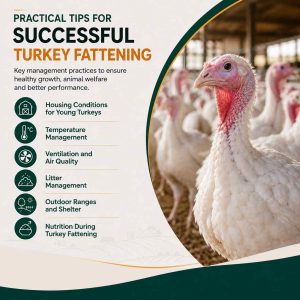
Practical Tips for Successful Turkey Fattening
Raising turkeys successfully requires good planning, proper housing conditions, balanced nutrition and careful management during each stage of growth. Compared to chickens, young turkeys are more sensitive in the first weeks of life and require special attention, particularly when it comes to temperature, ventilation, hygiene and feed quality.
Turkey fattening can generally be divided into two main phases:
- Brooding period with heating – from day-old poults up to 4–5 weeks of age
- Growing and finishing period without additional heating – from 4–5 weeks of age until the end of fattening
Housing Conditions for Young Turkeys
The facility used for brooding young turkeys should be dry, clean, well ventilated and protected from sudden temperature changes. It should also provide proper lighting, adequate air humidity and biosecurity measures that prevent access by unauthorized persons, domestic animals, wild birds and other potential disease carriers.
Floor space is one of the key factors that directly affects growth performance, flock uniformity and overall health. During the first four weeks, up to 12 poults per m² can usually be placed in the brooding area. Later, stocking density should be adjusted according to the expected final body weight.
As a general guideline, the final stocking density should not exceed:
- 34 kg of live weight per m² in intensive production systems
- 25 kg of live weight per m² in extensive or semi-intensive systems
Insufficient space can quickly lead to wet litter, increased humidity, poor air quality, slower growth, uneven body weight and higher mortality. Overcrowding may also increase the risk of feather pecking and cannibalism, which can become a serious welfare and management problem.
Temperature Management
Young turkeys require higher temperatures than broiler chicks during the first days of life. Heating is usually needed for the first 4–5 weeks.
During the first week, the temperature under the brooder should be approximately 35–38°C, while the room temperature should be around 24–27°C. After that, the temperature can be reduced gradually by about 3°C per week, until it reaches approximately 20–22°C by the sixth week.
At that point, turkeys can usually be kept at normal room temperature, provided that the house is dry, well ventilated and protected from drafts.
Ventilation and Air Quality
Ventilation becomes increasingly important as turkeys grow. Larger birds produce more moisture, dust and harmful gases, so fresh air supply must be carefully managed.
Good ventilation helps remove excess humidity, ammonia and dust, while also supporting respiratory health and better growth performance.
Recommended ventilation guidelines include:
- For day-old poults: approximately 3 m³ of air per hour per 10 birds
- For older turkeys: approximately 5–7.5 m³ of air per hour per kg of body weight
Fresh air requirements can also be linked to feed intake. As a rough guideline, for every 1 kg of feed consumed per day, turkeys require approximately 70–90 m³ of fresh air per hour.
When using mechanical ventilation, air inlets must be properly dimensioned to ensure an even supply of fresh air without creating drafts.
Litter Management
Litter quality has a major impact on bird comfort, hygiene and health. Suitable litter materials include soft untreated wood shavings, wheat or rye straw, sunflower husks, pumpkin husks and similar materials with good moisture absorption.
The litter must always be dry, clean and safe. Rotten, moldy or chemically contaminated materials should never be used, as they may negatively affect bird health and performance.
As a general rule, around 8.5 kg of wood shavings or straw per m² of floor space is required.
Outdoor Ranges and Shelter
In extensive or semi-intensive systems, turkeys may also have access to outdoor ranges such as pastures, orchards, grasslands or areas with low shrubs.
When choosing an outdoor area, preference should be given to well-drained, sunny terrain, ideally with sandy or limestone soil. However, shaded areas are also important, as turkeys need protection from strong sunlight, wind, rain and predators.
Trees, bushes, hedges, stone walls or simple shelters can provide birds with shade, protection and a greater sense of security. If fencing is used around the range, trees should not be positioned too close to the fence, as turkeys may use them to fly over.
Nutrition During Turkey Fattening
Proper nutrition is one of the most important factors in successful turkey production. Turkeys have high nutritional requirements, especially during the early growth stages, when muscle development is intensive.
A turkey may consume around 250 g of feed per day, depending on age, body weight, production system and feed formulation.
A well-structured feeding program should follow the bird’s growth stages:
- Starter phase: up to 4 weeks of age, with approximately 28% protein
- Grower phase: from week 4 to week 8, with approximately 24% protein
- Developer phase: from week 8 to week 14
- Finisher phase: from week 14 until the end of fattening, with approximately 16% protein
Protein levels should gradually decrease as birds grow, while energy, amino acids, minerals and vitamins must remain properly balanced. This helps support efficient growth, strong skeletal development and good final body weight.
Final Thoughts
Successful turkey fattening depends on the combination of good housing, proper temperature control, effective ventilation, dry litter, enough space and a balanced feeding program. Each of these factors plays an important role in bird welfare, flock uniformity and production results.
By carefully managing the environment and using feed adapted to each growth phase, producers can achieve healthier flocks, better performance and more predictable production outcomes.
Inberg provides nutritional solutions and feed programs designed to support turkey growth throughout all fattening stages — from starter to finisher.