
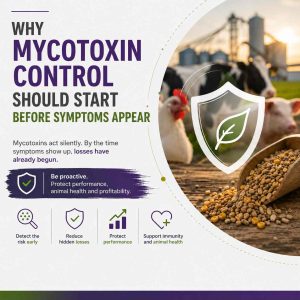
Why Mycotoxin Control Should Start Before Symptoms Appear
Mycotoxins are one of the most challenging risks in animal nutrition because their effects are not always visible at first sight. In many cases, animals may already be exposed to contaminated feed long before clear clinical symptoms appear. By the time a farmer notices reduced feed intake, slower growth, reproductive issues, digestive problems or increased disease sensitivity, production losses may already have started.
That is why mycotoxin control should not be treated only as a reaction to visible problems. It should be part of a preventive feeding strategy.
The Silent Impact of Mycotoxins
Mycotoxins are toxic compounds produced by certain molds, and they can contaminate grains and feed ingredients both in the field and during storage. Even when feed looks normal, contamination may still be present. FAO emphasizes that mycotoxins remain a continuous problem in food and feed chains despite good agricultural, storage and distribution practices, with consequences for animal health, productivity and trade.
One of the biggest challenges is that mycotoxins often act silently. At lower or moderate levels, they may not cause dramatic symptoms immediately, but they can still affect nutrient digestion, metabolism, immunity and overall animal performance. Scientific reviews describe that even lower concentrations may disrupt digestion, absorption and physiological functions in food animals.
In practice, this means that animals may continue eating, growing and producing — but not at their full potential. The result can be poorer feed conversion, uneven growth, weaker immunity, lower reproductive performance or increased sensitivity to other diseases.
Waiting for Symptoms Can Be Expensive
Visible symptoms are usually the final signal, not the first warning. When clinical signs become obvious, the animal has often been under stress for some time. This is especially important in intensive production, where even small drops in performance can have a major economic impact.
Mycotoxin exposure is also rarely limited to just one toxin. Feed ingredients may contain several mycotoxins at the same time, and their combined effects can be more difficult to predict. This is why relying only on visual feed quality or waiting for symptoms is not enough.
Preventive use of a mycotoxin control product can help reduce the risk before performance losses become visible. Mycotoxin-adsorbing agents are used to reduce exposure by lowering toxin bioavailability in the gastrointestinal tract, which can reduce uptake and distribution to blood and target organs.
When Preventive Use Makes Sense
A preventive approach is especially important during high-risk periods, such as after a wet harvest, during warm and humid storage conditions, when using raw materials of uncertain origin, or when changing suppliers. It is also recommended when production results are inconsistent without an obvious reason.
Mycotoxin control products should not replace good raw material control, proper storage, ventilation, moisture management and laboratory testing. Instead, they should be used as an additional safety layer within a complete mycotoxin risk management program.
Prevention Protects Performance
The goal is not only to avoid visible disease. The goal is to protect performance, feed efficiency, immunity and profitability. Animals do not need to show severe symptoms for mycotoxins to have an economic effect.
A well-designed mycotoxin control strategy helps producers act before problems escalate. Inberg’s technical materials also emphasize the importance of combining strong binding capacity with targeted biological support, such as immune and liver-support components, as part of a broader approach to mycotoxin risk management.
In mycotoxin management, prevention is not an extra cost — it is a way to protect the full value of feed, animal health and production results.