
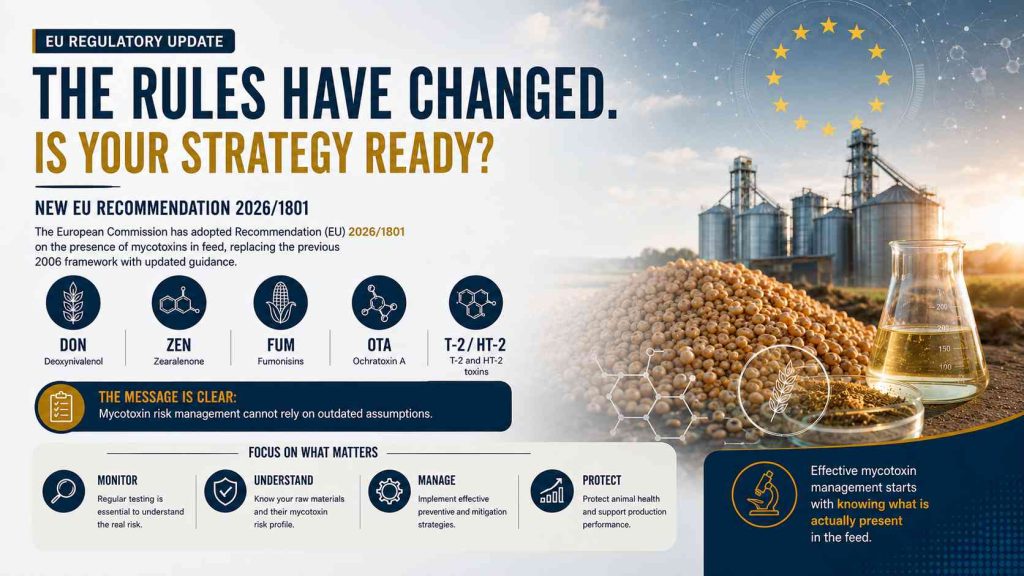
EU Recommendation 2026/1801: Updated Mycotoxin Guidance for Animal Feed
The European Commission adopted Recommendation (EU) 2026/1801 on 24 July 2026, introducing updated guidance on the presence of several important mycotoxins in animal feed.
The Recommendation covers:
- Deoxynivalenol, or DON
- Zearalenone, or ZEN
- Ochratoxin A, or OTA
- T-2 and HT-2 toxins
- Fumonisins B1 and B2
It was published in the Official Journal of the European Union on 28 July 2026. The general guidance values should be taken into consideration from 1 July 2027, while the values for maize, sorghum, soybean, sunflower and products derived from them should be taken into consideration from 1 October 2027. From 1 July 2027, the new Recommendation will replace Commission Recommendations 2006/576/EC and 2013/165/EU. (Eur-Lex)
Although Recommendation (EU) 2026/1801 is sometimes described as introducing new EU mycotoxin limits, this is not technically precise. Under Article 288 of the Treaty on the Functioning of the European Union, recommendations do not have binding force. The values in the Annex are therefore guidance values rather than statutory maximum levels. Nevertheless, they are expected to play an important operational role in evaluating feed acceptability, establishing HACCP critical limits and deciding what action should be taken when elevated mycotoxin concentrations are detected. (Eur-Lex)
Recommendation 2026/1801 at a Glance
| Date | Development |
| 24 July 2026 | Recommendation adopted by the European Commission |
| 28 July 2026 | Published in the Official Journal of the European Union |
| 1 July 2027 | General guidance values should be taken into consideration |
| 1 October 2027 | Guidance values should be considered for maize, sorghum, soybean, sunflower and their products |
| 1 July 2027 | Recommendations 2006/576/EC and 2013/165/EU are replaced |
The Recommendation also introduces a stronger emphasis on simultaneous multi-mycotoxin analysis, integration of guidance values into HACCP systems, information exchange throughout the feed supply chain and documented action when guidance values are exceeded. (Eur-Lex)
What Does EU Recommendation 2026/1801 Cover?
The Annex establishes guidance values for DON, ZEN, OTA, the sum of T-2 and HT-2 toxins, and the sum of fumonisins B1 and B2.
The values are expressed in mg/kg, or ppm, relative to feed with a moisture content of 12%. Different values are provided according to the mycotoxin, type of feed material, complete feed category and sensitivity of the animal species. (Eur-Lex)
This distinction is important. A concentration that may be considered acceptable for one feed material or animal category may not be appropriate for another. Young animals and certain sensitive species may require considerably stricter risk evaluation than less sensitive categories.
For complementary feed, the Recommendation states that the guidance values for complete feed should be applied while taking into account the prescribed proportion of the complementary feed in the total daily ration. The concentration in the complementary feed should also be evaluated in relation to its ingredient composition and expected use. (Eur-Lex)
The official Annex should therefore be consulted whenever analytical results are interpreted. A simplified summary should not replace evaluation of the relevant feed material, animal species and complete daily ration.
Why Was the Previous EU Mycotoxin Guidance Updated?
The previous European framework was based largely on scientific assessments and occurrence data available in the early 2000s, followed by separate guidance on T-2 and HT-2 toxins in 2013.
Since then, the European Food Safety Authority has published updated scientific evaluations and collected considerably more occurrence data on mycotoxins in feed. The European Commission also recognised the substantial regional and year-to-year variation in mycotoxin occurrence when developing the revised guidance values. The Recommendation explicitly refers to substantial changes as the reason for replacing the earlier documents. (Eur-Lex)
The update reflects a broader understanding of mycotoxin risk management. Feed safety can no longer be approached only by comparing an isolated laboratory result with one general reference value. Ingredient origin, animal sensitivity, inclusion rate, daily exposure and the possible presence of several mycotoxins must all be considered.
A Stronger Focus on Mycotoxin Co-Occurrence
One of the most important elements of Recommendation (EU) 2026/1801 is its explicit focus on mycotoxin co-occurrence.
The Recommendation calls for samples to be analysed simultaneously for DON, ZEN, OTA, T-2 and HT-2 toxins, and fumonisins B1 and B2 so that the extent of their co-occurrence can be assessed. (Eur-Lex)
This is highly relevant to practical animal nutrition because feed is frequently produced from several plant-based raw materials, each with its own contamination profile. Testing only one expected mycotoxin may therefore provide an incomplete picture of the overall exposure risk.
Co-occurrence should not automatically be presented as proof of a synergistic biological effect. The interaction between mycotoxins depends on the specific combination, concentrations, animal species, duration of exposure and biological endpoint being evaluated.
However, the simultaneous presence of several mycotoxins makes risk assessment more complex and supports the use of broader analytical panels rather than relying exclusively on single-toxin testing.
What Does the Recommendation Mean for HACCP Systems?
Recommendation 2026/1801 specifically states that feed business operators should use the guidance values in their Hazard Analysis and Critical Control Points systems to determine critical limits at relevant critical control points. (Eur-Lex)
For feed producers, this may require a review of several parts of the existing mycotoxin control programme:
- Risk classification of raw materials according to crop, origin and supplier
- Selection of appropriate single- or multi-mycotoxin analytical panels
- Definition of internal alert levels and escalation procedures
- Establishment of species-specific decision criteria
- Review of supplier specifications and certificates of analysis
- Documentation of actions taken when internal or EU guidance values are exceeded
- Communication of relevant mycotoxin information to customers and compound feed manufacturers
The Recommendation also emphasises that suppliers should provide compound feed manufacturers with sufficient information about the mycotoxin content of feed materials, particularly where those materials may be used in diets for sensitive animal species. (Eur-Lex)
In practice, mycotoxin management should therefore become more closely connected with supplier approval, purchasing specifications, laboratory testing, formulation decisions and documented feed-safety procedures.
What Happens When a Guidance Value Is Exceeded?
An analytical result above a guidance value should not be treated in exactly the same way as an exceedance of a legally binding maximum level. Nevertheless, it should not be ignored.
The Recommendation states that feed exceeding the guidance values should be placed on the market or used only where precautionary measures aimed at protecting animal health have been taken.
It also recommends careful assessment of feed materials, complete feed and complementary feed before they are placed on the market. Where relevant values are exceeded, appropriate action may include:
- Providing clear information about the mycotoxin content to the buyer
- Assessing the intended use of the feed
- Considering the animal species and production category
- Evaluating exposure through the total daily ration
- Conducting a documented feed-safety risk assessment
- Implementing appropriate risk-mitigation measures
Existing EU obligations requiring feed to be safe, fit for purpose and not harmful to animal or human health remain applicable independently of the non-binding status of the Recommendation. (Eur-Lex)
A guidance-value exceedance is therefore best understood as a trigger for structured evaluation and action—not as a result that can be considered in isolation.
From Mycotoxin Monitoring to Prevention
Laboratory monitoring provides essential information about what is present in raw materials and finished feed. However, testing alone does not reduce animal exposure.
An effective preventive programme should combine:
- Qualified raw-material suppliers
- Appropriate purchasing specifications
- Good drying, handling and storage practices
- Moisture and temperature control
- Risk-based analytical monitoring
- Correct interpretation of results
- Species-appropriate formulation decisions
- Scientifically evaluated mycotoxin-mitigation solutions
Where historical data, crop conditions or ingredient profiles indicate recurring or unpredictable exposure, the consistent use of an appropriately selected mycotoxin binder or mitigation product can provide an additional preventive layer.
Such products should not replace good feed hygiene, storage management or analytical testing. Their role is to complement these measures by helping manage residual exposure that cannot always be prevented through raw-material control alone.
Product selection should also be aligned with the identified mycotoxin profile. A product should not be assumed to perform equally against all mycotoxins simply because it is described as a binder. The relevant mode of action, recommended inclusion rate and available in vitro and in vivo evidence should all be considered.
INBERG’s Approach to Mycotoxin Risk Management
At INBERG, mycotoxin management is one of our core areas of product development and technical expertise.
Our approach begins with understanding the actual contamination profile and the sensitivity of the animals being fed. It then continues with the selection of an appropriate mitigation strategy supported by relevant analytical, in vitro and in vivo evaluation.
We develop and manufacture mycotoxin solutions for different levels and types of feed risk. Rather than treating every contamination situation as identical, we focus on matching the composition and mode of action of the product with the practical requirements of the market, feed producer and target animal species.
Recommendation (EU) 2026/1801 supports the same general direction: better data, greater awareness of co-occurrence, species-specific risk evaluation, stronger integration with HACCP and appropriate action before mycotoxin exposure becomes an animal-health or performance problem.
The goal of mycotoxin management is not only to respond to visibly contaminated feed. It is to establish a consistent system that protects feed quality, animal health and production performance over time.
Frequently Asked Questions
Is Recommendation (EU) 2026/1801 legally binding?
No. Under Article 288 of the Treaty on the Functioning of the European Union, recommendations do not have binding force. The values in Recommendation 2026/1801 are guidance values rather than statutory maximum levels.
However, the Recommendation is operationally important because it connects those values with feed acceptability, HACCP critical limits, precautionary measures, risk assessment and information exchange. Existing binding EU feed-safety legislation continues to apply. (Eur-Lex)
When should the new mycotoxin guidance values be used?
Most guidance values should be taken into consideration from 1 July 2027.
For maize, sorghum, soybean, sunflower and products derived from them, the guidance values should be taken into consideration from 1 October 2027. (Eur-Lex)
Which mycotoxins are included?
Recommendation 2026/1801 covers:
- DON
- ZEN
- OTA
- T-2 and HT-2 toxins
- Fumonisins B1 and B2
Does the Recommendation cover aflatoxin B1?
No. Aflatoxin B1 is not included in Recommendation 2026/1801. It is addressed separately under the EU framework for undesirable substances in animal feed, which establishes maximum levels for aflatoxin B1. (Eur-Lex)
Does the Recommendation require simultaneous multi-mycotoxin testing?
As a non-binding act, it does not impose a legal testing obligation in the same way as a regulation. It recommends that Member States ensure, with the active involvement of feed business operators, that samples are analysed simultaneously for the covered mycotoxins so that their co-occurrence can be assessed. (Eur-Lex)
Moving Forward with Updated EU Mycotoxin Guidance
Recommendation (EU) 2026/1801 is more than an update of numerical guidance values.
It strengthens the role of:
- Multi-mycotoxin monitoring
- Assessment of co-occurrence
- HACCP-based decision-making
- Species-specific risk evaluation
- Supplier-to-customer information exchange
- Precautionary and risk-mitigation measures
For feed producers and animal nutrition professionals, the transition period before July 2027 provides an opportunity to review sampling plans, laboratory panels, supplier specifications, HACCP procedures and existing mycotoxin-management programmes. (Eur-Lex)
At INBERG, we remain committed to combining scientific knowledge, practical feed-industry experience and properly evaluated mycotoxin solutions to help our partners manage contamination before it affects animal health and production performance.
Effective mycotoxin management starts with knowing what is present in the feed—and continues with knowing how to manage the identified risk.
Read the full official text and Annex on EUR-Lex: