
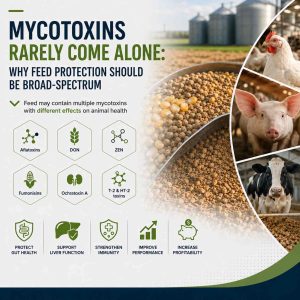
Mycotoxins Rarely Come Alone: Why Feed Protection Should Be Broad-Spectrum
When farmers think about mycotoxins, the first concern is often aflatoxin. This is understandable, because aflatoxins are well known, highly researched and strongly associated with serious health and production problems.
However, in real feed production, mycotoxin risk is rarely limited to only one toxin.
Modern animal feed is usually made from several raw materials, such as corn, wheat, barley, soybean meal and other plant-based ingredients. Each of these ingredients may carry a different mycotoxin risk, depending on weather conditions, harvest quality, storage conditions and raw material origin.
That is why a broader approach to mycotoxin control is essential.
More Than One Mycotoxin Can Be Present
Feed may contain different groups of mycotoxins at the same time, including:
- Aflatoxins
- Deoxynivalenol — DON
- Zearalenone — ZEN
- Fumonisins
- Ochratoxin A — OTA
- T-2 and HT-2 toxins
Each of these mycotoxins affects animals in a different way. Some primarily affect the liver, others may reduce feed intake, damage the intestinal tract, disturb immunity or influence reproduction.
The real challenge is that animals may be exposed to several mycotoxins at once. Even when the level of each individual toxin is not extremely high, their combined effect can still place stress on the animal and reduce performance.
Why Focusing Only on Aflatoxin Is Not Enough
Many traditional mycotoxin binders are mainly designed to bind aflatoxins. While this can be useful in situations where aflatoxin is the main problem, it may not provide enough protection when other mycotoxins are also present.
This is especially important because different mycotoxins have different chemical structures. A product that works well against one toxin does not automatically work equally well against all others.
For that reason, mycotoxin control should not be based only on one parameter or one toxin. A good strategy should consider the broader risk profile of the feed and the sensitivity of the animal species.
The Hidden Cost of Multi-Mycotoxin Exposure
Mycotoxin problems do not always appear as sudden disease outbreaks. In many cases, the first signs are subtle and easy to overlook.
Producers may notice:
- reduced feed intake
- poorer feed conversion
- slower growth
- uneven body weight
- weaker immunity
- more digestive problems
- poorer reproductive results
- lower overall production efficiency
These changes may have many causes, which is why mycotoxin risk is sometimes underestimated. However, when feed quality, storage conditions or raw material origin are questionable, mycotoxins should always be considered as a possible contributing factor.
What a Broad-Spectrum Strategy Should Include
Effective mycotoxin management starts before the feed reaches the animal.
A complete approach should include:
- careful selection of raw materials
- proper storage and moisture control
- regular testing of high-risk ingredients
- good hygiene in feed storage areas
- monitoring of animal performance
- use of a reliable mycotoxin control product
A broad-spectrum mycotoxin product should be designed not only to bind toxins in the digestive tract, but also to support the animal during toxin-related stress.
This is why modern solutions often combine mineral components with additional functional ingredients, such as yeast cell wall components, immune-supporting ingredients and liver-supporting botanical extracts.
Protecting the Animal, Not Just the Feed
The goal of mycotoxin control is not only to improve the quality of feed on paper. The real goal is to reduce the biological impact of mycotoxins inside the animal.
A good mycotoxin management program helps protect:
- gut health
- liver function
- immune response
- nutrient utilization
- growth performance
- reproductive efficiency
- overall farm profitability
When animals are better protected from mycotoxin stress, they can use feed more efficiently and express their production potential more consistently.
Final Thoughts
Mycotoxin risk should never be viewed through only one toxin. Aflatoxin is important, but it is only one part of a much wider challenge.
In practical feed production, several mycotoxins may be present at the same time, and their combined effects can reduce animal health, performance and profitability.
That is why a broad-spectrum, evidence-based approach is the best foundation for modern mycotoxin management.
By combining good raw material control, proper storage, regular monitoring and the right mycotoxin control solution, producers can reduce risk and support healthier, more productive animals.